

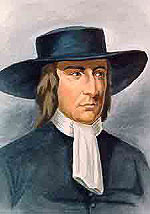
George Fox, Founder
The formal name of the Quaker community is the “Religious Society of Friends,” and Quakers are often called simply “Friends.” There are about 300,000 Quakers worldwide. The largest groups are in Britain, North America, Kenya, and Bolivia. But Quakers meet together on every continent.
The Central Idea of Quakerism
George Fox, a shoemaker and shepherd, founded Quakerism in England in the 1600s. George Fox articulated the idea that there is something of God in everyone. “That of God” may be hard to see in some people, but it is there.
This was George Fox’s fundamental insight from which everything else in the Religious Society of Friends derives. It means that there is no need for a priest to mediate between you and God. Listen to the inner light within you, act upon it, and share what you hear. Early Quakers were driven by this insight and proclaimed it widely. To them this was a return to the ideas of early Christianity.
We have no standard definition of what we mean by “something of God.” “God” is a difficult word for many, and expressions such as “the light within,” or “the force for good within” also express the idea at the heart of Quakerism. Many Quaker groups, including Orange Grove Friends, are highly inclusive, welcoming and respectful of the beliefs of those of every religious tradition as well as persons of no religion.
The idea of something of God in everyone is not unique – many faiths would say similar things – but for Quakers it is the central idea.
Sunday Service
Two main traditions of Quaker Sunday services have evolved. In the “programmed” tradition, much of the Sunday meeting/service is pre-planned. Often pastors organize the service and deliver a sermon. While the programmed services may look on the surface like those of other churches, they always hold to the central idea of Quakerism – “that of God in everyone” – as well as Quaker values and traditions going back to George Fox and his early followers.
In the “unprogrammed” tradition, the one which Orange Grove Friends Meeting follows, Quakers sit together in companionable silence every Sunday for an hour. But occasionally someone among us speaks and shares an insight – something that they have read, that they have experienced, or a realization that they have gained. This often leads to others speaking in terms that relate to what has been said. And, occasionally, a brave soul may begin a song, and if we know it, others join in. Singing highlights our sense of welcoming and warmth in each others’ company.
Children are welcome, too. They usually play and learn in Sunday School while their parents are at Sunday service. In the case of the Orange Grove Meeting, the children join the companionable sitting either for 10 minutes at the beginning or end. Childcare is also available for younger children for the entire hour.
Quaker Beliefs
The guiding beliefs of Quakerism are called “Testimonies.” For example, our Peace Testimony is that peaceful resolutions to conflict should always be sought. Other Testimonies are: Integrity, Simplicity, Community, Unity, and Equality. For more information about the Testimonies, click here.
Quaker Advices and Queries
“Advices and Queries” provide guidance for practicing in daily life the central idea that there is that of God in everyone. Guidance is given both as advice and by asking Friends to consider a “query.” For example, one advice is “Live adventurously” or “Let your life speak” (act on your beliefs). A query that relates to these guidances is, “When choices arise, do you take the path of using your gifts to follow the light within and to serve your community?”
Over the centuries, the Testimonies, like those of Peace and of Equality, as well as Advices like “Let your life speak” have led many Quakers to participate actively in the big issues of their times – the abolition of slavery, peaceful resolution of conflicts, women’s rights, and many others. Some Quakers are well-known historical figures such as William Penn, Susan B. Anthony, and John Greenleaf Whittier, but countless others have played roles in contributing to human progress. Quakers are enjoined to be active in the world in which they live, and this website tells some of this story.
Source: The original version of this article was published as “Who Are Quakers?” by the Chilterns Quaker Programme in Buckinghamshire, England, to whom we express appreciation. Minor revisions have been made in content and wordings in order to relate it to the Orange Grove Friends Meeting. It was originally published under the following open access copyright notice: Content on this site is licensed under a Creative Commons Attribution 3.0 License.
Click for FAQs on Quakers.
Click for a Glossary of Quaker terms.